Head Lama of Mongolian Buddhism
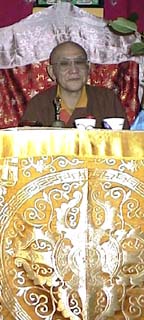
His Holiness the Dalai Lama formally announced the existence of His Eminence the Ninth Khalkha Jebtsundampa, Jampal Namdrol Chokye Gyaltsen, in September 1991. The Khalkha Jebtsundampa is the head lama and lineage holder of Buddhism in Mongolia. The Ninth Khalkha Jebtsundampa is considered to be one of the most revered teachers of the Kalachakra Tantra, the Tara Tantra, and Maitreya, the future Buddha. All of these lineage teachings descend directly to him from Taranatha, the great historian and Tantric practioner (b. 1575 AD).
When the Ninth Khalkha Jebtsundampa's incarnation was recognized at the age of four by Rentung Rinpoche, the Regent in Lhasa, as well as other high lamas and the state oracles, his identity was kept secret due to Stalin's influence on the Communist Party in Mongolia, and their oppression of Buddhism in that country. Customs and traditions were buried or lost until the recent visits of H.H. the Dalai Lama, the last time being in August 1995 when he gave the Kalachakra Initiation. The Ninth Khalkha Jebtsundampa was born at Tromtsikang and then moved to Shol, just below the Potala. His father, Lobsang Jampal, was from Phenpo and his mother, Yangchen was from Kham. At the age of seven, he entered Gomang College, Drepung Monastery, as a simple monk where he studied philosophy for fourteen years, up to the level of Madhyamika. At Gomang he studied primarily with a teacher from Mongolia named Geshe Thupten Nyima. He received his Dharma lineages from His Holiness the Dalai Lama. Panchen Rinpoche, Trijang Rinpoche, Ling Rinpoche, and Lhatsun Rinpoche were his teachers in the Gelug lineage. Dilgo Khyentse Rinpoche was his teacher in the Nyingma lineage; Kalu Rinpoche was his teacher in the Kagyu lineage; and Sakya Trizin was his teacher in the Sakya lineage. At the age of 21, he left Gomang College and Drepung to engage in a series of Chod retreats, living the life of a yogi, while on pilgrimage to the holy sites of Tibet. At the age of 25, he gave back his monastic vows, and then went to stay at Ganden Phunstok Ling, established by his predecesor Taranatha, until the age of 29 when the Chinese invasion forced him into exile, along with hundreds of thousands of Tibetans. In India, he lived with his family in Darjeeling and Mysore, until 1981, and later in Madhya Pradesh in central India until 1990, quietly serving as lama for the Tibetan community throughout that time. During this period of time, Rinpoche did many retreats and gave public teachings in the Tibetan settlements several times a year. In 1991, with the dissolution of the Soviet Union and the new found religious freedom felt in Mongolia, many Mongolian monasteries sent their abbots, lamas and ministers to India to request the Dalai Lama in Dharamsala for information regarding the Ninth Khalkha Jebtsundampa. Did His Holiness know where he was, who he is, and could the Dalai Lama recognize him for the peoples of Mongolia? It was at this time, under the auspices of the Religious Office of the Tibetan Government in Exile, that the Dalai Lama gave the official stamp of recognition and acknowledgement of His Eminence the Ninth Khalkha Jebtsundampa, the spiritual lineage head of Buddhism in Mongolia. It was also at that time, when His Eminence Khalkha Jebtsundampa moved to Dharamsala to be closer to His Holiness the Dalai Lama, that he was officially enthroned as the Ninth Khalkha Jebtsundampa, amid great and joyous celebration. His Holiness the Ninth Khalkha Jebtsundampa has founded the Takten Kalachakra Project to establish an institute for the study of Buddhist Philosophy and the Kalachakra Tantra as well as other aspects of the Vajrayana. The institute will be located in Dharamsala, the residence in exile of His Holiness the Dalai Lama. The First Jebtsundampa, Under Gegeen Zanabazar, was born the son of a Khan in Mongolia. He was recognized at an early age to be an incarnate lama and, at the age of fourteen, (ca. 1650), he made a pilgrimage to Kumbum, the birthplace of We Tsongkapa. From there, he travelled to Central Tibet to visit the Fourth Panchen Lama, Panchen Losang Chogyen, and the Fifth Dalai Lama, Ngawang Losang Gyatso. It was at this time that the Fifth Dalai Lama recognized the young Tulku to be the reincarnation of the saint Taranatha, who was greatly respected as a chief lineage holder of all traditions, with reincarnations going back directly to Shakyamuni Buddha. Both the Fifth Dalai Lama and the Fourth Panchen Lama then became Jebtsundampa's teachers and gave to him all the initiations, oral transmissions, and commentaries. His title was also conferred upon him at that time. He then returned to Mongolia where he strongly established Buddhism throughout Mongolia and Central Asia. The First Jebtsundampa had a very long life, which added to his enduring influence as the head lama of the many monasteries throughout the region. While the First through the Fifth Jebtsundampas had been fully ordained monks, the Sixth through Eighth later married and took consorts. Jebtsundampa's close friendship with the Dalai Lama in this lifetime dates back to the early years in Tibet, before 1959, when they had shared tutors in their youth and remembered meetings for play and family gatherings at Norbulinka. Their present friendship continues the long tradition of close ties that they have held historically. It was the Fifth Dalai Lama, Ngawang Losang Gyatso, who recognized the First Khalkha Jebtsundampa as the reincarnation of Taranatha when the young tulku first travelled to Tibet from Mongolia, and who also became his lineage lama at that time, conferring on him all his lineage initiations, empowerments and the further teachings, as well as his present title. The Sixth Dalai Lama recognized Khalkha Jebtsundampa as the emanation of Chakrasamvara and Vajrapani in the Tantric sense; and as Namkai Nyingpo in the Bodhisattva sense. Later, during the time of the Seventh Dalai Lama, the Fourth Jebtsundampa took rebirth in the same family, making them blood relatives as well. In 1911, when Mongolia declared itself to be an independent country, the Eighth Jebtsundampa was enthroned as King. The Thirteenth Dalai Lama and the Eighth Jebtsundampa extended their bond of understanding into the temporal realm, by each exchanging official documents of mutual recognition of the independence of both Tibet and Mongolia, in 1911; and later, in 1913, by having their representatives sign a treaty at Urga (now Ulaanbaatar) "declaring their independence from China and agreeing to strengthen Tibeto-Mongolian ties." Khalkha Jebtsundampa has realized incarnations in all the major Tibetan lineages. Prior to his incarnation as Taranatha, he was known as Jamyang Choje, who established Drepung Monastery outside Lhasa. In the Nyingma, he was Rongzong Lotsawa Chokyi Gyaltsen; in the Kagyu, Baromba Dharma Wangchuk; in the Sakya lineage, he was known as Master Kunga Drolchok. It was after this incarnation that he was to be reborn as Taranatha. But at that time, the mother of Taranatha was still only a young girl of fourteen; so instead, he took rebirth as the son of an Indian king. He lived so, until he was fourteen years of age. At th at time, as he stood one day on the roof of the king's palace, his dakini mother, whose name was Khadroma Yum Dorje Buka, appeared to him in the sky and bade him come to her. He then took rebirth as Taranatha. Taranatha's work is of special interest with respect to the Tantric period of Buddhism in India. Later, while teaching in Tibet, he established Takten Phuntsok Ling Monastery, about three hours outside Shigatse, which had 500 monks and many branch monasteries throughout Tibet. At that time, Taranatha gave the Kalachakra initiation two or three times each year at this monastery, later renamed Ganden Phuntsok Ling. In his later years, Taranatha, who was known for his great wit and humor, had joked during a teaching about where he might take rebirth. It was said that a Mongolian student who was present had spoken out and pleaded, "Oh, please come to Mongolia next time!" It was said that this remark set up the conditions for his next rebirth. Taranatha was the 14th notable reincarnation and directly preceded the First Khalkha Jebtsundampa. As the Fifteenth reincarnation, the first Khalkha Jebtsundampa became the lineage-lama of the many monasteries throughout Mongolia.The Jebtsundampa Lineage
The Great Taranatha
(On to the An Interview with the Ninth Jebtsundampa...)
(Back to the Site Guide...)
copyright © Stuart Hertzog 1998