A commentary on the history of Buddhism in Mongolia
by Stuart Hertzog
From A Modern History of Mongolia by Bawden,
published by Keegan Paul, 1985
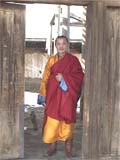

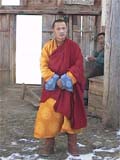
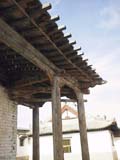
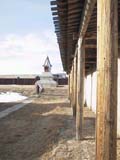
The Jebtsundampa Khutuktu is regarded as a Living Buddha, and is the highest incarnate lama and Head of the Faith in Mongolia (Bogd Lam, or Most Holy Lama). The Manchu Emperors tacitly recognized this, and even when the Khalkha, the original tribes of Inner Mongolia, submitted to them at the end of the seventeenth century, and long after, the Manchus treated the Jebtsundampa Khutuktu as a temporal and spiritual authority. However, to curb any potential threat, the Emperor Ch'ien Lung decreed that the third and all future incarnations were to be found in Tibet, which tradition persists to this day. During the brief period of autonomy from 1911 to 1919, the Eighth Jebtsunsdampa Khutuktu was the spiritual and temporal King of Mongolia.
(Back)
Zanabazar (1635-1723) the first Jebtsundampa Khutuktu, was one of the great figures of Mongolian Buddhism. Son of the Tushetu Khan Gambodorji (1594-1655), one of the three territorial chieftains or khans of the Khalkha, it was prophesied even before birth that he would be a future leader of the Khalkha. His early childhood was attended by miraculous events, and he was given the name Under Gegeen, which means "High Brilliance" and referred to as the "Brilliant Child." Examined by a soothsayer, he was found to have all the marks of a Buddha on his body. Zanabazar was enthroned as a Living Buddha and Head of the Faith in 1639 at a great meeting of the Seven Banners of the Khalkha. Educated in Mongolia until 1649, he then was sent to Lhasa to receive a Tibetan education under both the Dalai and Panchen Lamas, including higher ordinations from the Dalai Lama, who bestowed upon him at the age of 15 the title Jebtsundampa. Zanabazar was renowned as an outstanding scholar and a sculptor, and was reputed to have magical powers in addition to his fine intellect. He took a consort, known as the "Girl Prince," and a famous legend describes how Khalkha nobles, who took objection to this, were silenced by an impressive demonstration of her own miraculous powers. Before their eyes, she was able to knead a lump of hot, molten bronze into a Buddha figure with her bare hands, without being burned. When she died, her right hand survived the cremation and ashes from it were incorporated into the materials for a religious book. (Back)
The Fourth Jebtsundampa Khutuktu (1774-1813) was the longest-living of the incarnations between the Second and the Eighth. He apparently had a sense of clerical discipline, issuing in 1797 an encyclical letter to the monasteries condemning the endemic excessive trading and money-lending, along with brawling and rowdyism, singing and archery, chess-playing and smoking. This had little effect on behavior in the monasteries, except to get himself known in consequence as the "terrible incarnation," and probably eventually killed for his meddlesome ways, because he died at the suspiciously early age of 38, very much like the Second, who died at the age of 36, murdered, so it was thought, by the Manchus, who then issued a decree banning future incarnations of the Jebtsundampa Khutuktu in Mongolia. In 1793 much stricter regulations were issued, governing all the reincarnations of Tibet and Mongolia, and specifically excluding all noble families from consideration when any child incarnation was to be sought. See also the Sixth Jebtsundampa below. (Back)
Erdene Zuu is a great walled temple complex, started in 1586 by Abdai Khan of the Khalkhas, but not finished until 300 years later. At its height, the compound contained up to 60 temples, with 300 felt gers housing lamas and the visiting faithful. The building of Erdene Zuu marked the beginning of the Buddhist revival in Khalkha. The walls were built with stones taken from the ruins of nearby Kharakhorin, the Mongolian capital city whose construction was started by Genghis Khan in 1220. Completed after his death by his son Ogedei Khan, ancient Kharakhorin was abandoned when grandson Kublai Khan moved the capital of the Yuan dynasty (1271-1368) to what is now Beijing. The remaining buildings were later totally destroyed by the Manchurian hordes. The walls of Erdene Zuu contain 108 large stupas, 24 per side plus four at each corner. Some magnificent buildings survive inside this mediaeval religious complex, but they now are only a museum to attract and impress tourists, and only one small temple remains active. Recently, rare and important accounts of ancient Imperial life have been discovered written on stones found in the walls. (Back)
The Sixth Jebtsundampa Khutuktu died at the age of six, occupying the throne for only 39 days. He may have met a similar fate to the Third Jebtsundampa Khutuktu, the first to be born in Tibet, who was ill-treated from an early age by his guardian lamas as they already supported an alternative candidate vying for the title. He died, or more probably was killed, at the age of 16. Apart from the First, the Second and the Eighth Jebtsundampa Khutuktus, none of the unfortunate intermediate incarnations played any significant part in state affairs, most likely because they died or were assassinated before they could do so. (Back)
The Eighth Jebtsundampa Khutuktu (1868-1924) was born in Tibet. He was a drunkard and a syphilitic of all-embracing sexual tastes, who suffered from blindness caused by the disease. His lifestyle was very much like that of the Seventh Jebtsundampa, who early in his career gave himself up to drinking, whoring and homosexuality, to the great scandal of many lamas of Urga (now Ulaanbaatar), who tried to enlist the help of the Manchus to have him removed. The lax morality of the later Jebtsundampa Khutuktu was symptomatic of the degenerate state of social and ethical irresponsibility existing in Mongolian monasteries at that time, a factor which eventually brought about their destruction and replacement of the religious monarchy by the authoritarian Communist régime. However, despite their degeneracy, these Jebtsundampa Khutuktus enjoyed continuous popular veneration and respect, and were seen as the only figures capable of uniting Mongolia as a nation. After the Manchu Empire finally collapsed in 1911, the Eighth Jebtsundampa Khutuktu was declared the first King of an independent Mongolia on December 1st of that year. He was given the title Bogd Khan (Holy King), and reigned until the Communist revolution of 1921. (Back)
Abdai Khan of the Khalkhas was another important figure in the dissemination of Buddhism in Mongolia. In 1577, he journeyed from his territories near Kharakhorin to meet the Third Dalai Lama in Köke quota, the capital city built by Altan Khan in the middle of the 16th century, and convert to Buddhism. The Dalai Lama then gave him his title of Khan. Abdai Khan then ordered the building of the major Buddhist center of Erdene Zuu (q.v.) and the publishing of many religious books, which he received from Altan Khan. This marked the beginning of the Buddhist revival, long after it first appeared in the region in the seventh century. This time, the religion was to take firm hold in Mongolia. (Back)
Genghis Khan also spelled Chinggis Khaan (1162-1227) is the most famous Mongolian of all time. He united the warring tribes of Mongolia into a mighty fighting force that swept east through China, and west to the shores of the Caspian and Arabian Seas. His mystical, four-tailed black banner, 13 cubits (2.6 metres) high, was a terrible and terrifying object for the millions who suffered the scourge of the invading Mongolian armies. Surmounted by a sharp, 30cm. spearhead and star, the banner's black fringe was made from the manes and tails of selected stallions, kept unclipped since birth. Under the sharp spearhead was a silver disk with 81 holes; the fringe was hooked into the disk through these using goatskin thongs as ties. Girdled by a belt, it was draped with four silk pendants, each bearing a round, bronze disk. Sacrifices of the still-beating hearts torn from the breasts of living prisoners of war, accompanied by the slaughter of five strong male animals — a stallion, a camel, a goat, a sheep and a bull — were made to it at extreme times, such as a declaration of war, a natural disaster, or a victory over an enemy. The power of the emblem was so strong that no woman was ever allowed to participate in the ceremony. Between times, the banner was placed outside the Khan's ger (round Mongolian felt tent), standing on the back of a stone turtle, surrounded by smaller standards on stone pedestals. That it was kept at Western Khuree was a special honor. Chinggis Khaan's black banner is still revered and worshipped as a powerful ritual object. The last sacrifice ceremony took place as late as the summer of 1995 on Buurkhan Khaldun Mountain, on the order of Mongolian President Ochirbat — without the still-beating hearts, as this gruesome ritual was last performed in 1932. (Back)
The Central Khalkh was the territory controlled by the Khalkha, the group of tribes under seven banners that inhabited what is now Mongolia. The three Khans of the Khalkha were the Zasagtu Khan, the Tushetu Khan, and the Setsen Khan. All were direct descendants of the powerful Altan Khan, of the Tumet (1507-82), a grandson of Genghis Khan. Altan Khan was responsible for the reformed or Yellow Hat (Gelug) school of Tibetan Buddhism becoming dominant in Mongolia. He first converted to Buddhism in 1573 when he encountered a Buddhist lama on one of his military campaigns. He went on to establish hegemony over the Khalkhas when he captured the former imperial capital of Kharakhorin from the western Mongolian Oirats, thus bringing to an end many years of bitter civil war. In 1575, Altan Khan was persuaded by a nephew, Khutuktu Setsen Khungtaiji, to invite the future Third Dalai Lama to visit him, pointing out to the now-aging Altan Khan the benefits that would accrue by developing a relationship between Buddhism and the State, as they had previously existed in the great Mongol Empire. During this historic visit, Altan Khan conferred upon his visitor the title of Dalai Lama, which then was applied retrospectively to the two predecessors. In return, the Dalai Lama proclaimed himself to be an incarnation of Pagspa Lama, the great spiritual advisor to Mongol Emperor Kublai Khan, and Altan Khan to be a reincarnation of Kublai Khan himself. After Altan Khan died in 1582, and the Dalai Lama passed away in 1588 while returning to Mongolia at the invitation of the Emperor Tumen Jasagtu Khan, nobles of the Tumet seized the opportunity to declare a member of Altan Khan's family as the next Dalai Lama, thus establishing the historical interdependence of the two great Buddhist cultures of Tibet and Mongolia, as well as strengthening their own position in the temporal and spiritual hierarchy of the region. (Back)
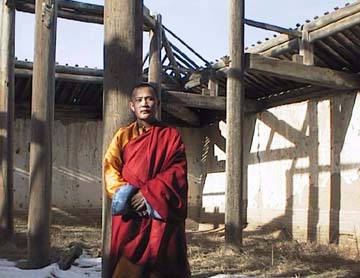
Following the Communist takeover by the Mongol Peoples' Party in Mongolia in 1921, increasing pressure was brought on the monasteries to disband and for monks to take up secular life. This effort culminated in the final destruction of the monasteries in 1937, when most of the high incarnations were liquidated, almost all remaining monasteries destroyed, some by artillery and explosives, and their monks forced into civilian life, sent to concentration camps in Siberia, or executed. Lamaseries were shut down or ruined, precious religious objects smashed, and gold and silver melted into bullion. This action ended the long epoch of tribal and religious feudalism in Mongolia, closing the door to Mongolia ever again becoming a religious autocracy. The communist era ended in 1990, when social and religious freedom was restored. A modern, democratic, secular state now exists in Mongolia, and many monasteries, including Shankh Khiid, are now being restored. (Back)
(Back to A History of Shankh Khiid...)
(Back to Site guide...)
copyright © Stuart Hertzog 1998