Part One: We Need More String
First impressions of a patched-together city
by Stuart Hertzog
OCTOBER 22ND, 1998

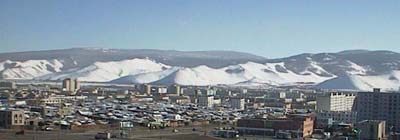
 he vast, empty vistas of the Gobi desert, crossed by long, serrated mountain ranges, unroll beneath the path of our Air China 737 jet. After what seems like an eon of time, they give way to the wide grasslands of southern Mongolia. Tiny white dots, the round felt tents of the nomadic Mongolian herders, are the only signs of human habitation. Great wide parallel tracks scar the ground, spreading in all directions. What could have caused them? From my eagle-high vantage, I gaze down at the ancient landscape, wondering. Are they roads, railways, or animal tracks? An occasional tiny collection of tents and houses that make up the small villages and occasional town, pass beneath. Suddenly, Ulaanbaatar appears, a jarring reminder of modern industrial civilization. As the aircraft circles the mountains that contain the city in a broad valley, the machine-like spacing of the long apartment blocks and the broad, arrow-straight boulevards filled with traffic, bring this long-distance jet traveler back to the 20th century with a thump.
Into the end of the 20th century, but not quite up-to-date. The aircraft lining the taxiways as our airplane trundles in are an odd collection of second-hand military equipment and 1970s Russian airliners. Anachronistic freight biplanes stand beside bedraggled propjets. Ugly Russian helicopters, many in an obvious state of cannibalization, hint of a lack of spare parts. "Welcome to Ulaanbaatar" says the sign above the airport terminal. It could have added: "we hope you brought some more string." The cannibalized aircraft were a clue. In Ulaanbaatar, not everything always works as it should. Mongolia's capital is a city held together with baling wire. Welcome to the developing world.
 erhaps I'm being unfair. In UB, as it's known to the natives, everything works -- almost all of the time. But perhaps not in a way that we from the Western Paradise expect. Mongolians are masters of the art of the field repair, jigging things together so that they once again perform. Just don't look too closely, or touch any of the exposed wiring. Don't expect electric light in the apartment hallways; and never take your finger off the elevator button. As for hot and cold running water: use them while they're there. In an instant, they could be gone. But don't worry, they'll be back -- eventually. Nobody knows just when.
Let me illustrate the cheerful state of uncertainty that is the mark of modern Mongolia. When I arrived with my baggage at the apartment block in which I would be staying, the elevator was out of service. "It's been that way for three weeks!" Javhlan smilingly informed me. Javhlan (pronounced "Jachlin" with a guttural "ch") is a translator by profession. Together, we lugged my bags into the hallway and started up the stairs. There, I received my second shock. There is no lighting on the apartment stairs -- none -- and only one broken window per floor. The entrance to each level is literally a person-sized hole cut into the concrete wall, and the floor tiles are uneven and broken. The elevator stayed unfixed for the next six days.
 don't want you to get the impression that Javhlan's apartment block is a slum, or anything like that. All the apartment blocks are that way. Javhlan lives on the six floor, so for a week I had to walk up and down six times two flights of nine stairs, for a holy total of 108 stairs. One mantra per stair, and it's a whole rosary of rising or falling. Considering that Ulaanbaatar is situated at an altitude of 3,500 feet, it's also good training for the next Olympics. Luckily, the elevator is now fixed, otherwise I'm sure I would be by now. Yes, my legs are much stronger, thank you, and the breathlessness and headache are quite gone away.
Then there's the door to Javhlan's apartment. For security, or for defense against the cold winds that blow through the hallways in winter, or both, every apartment has double doors, each with at least one lock. If you think the Mongolian elevators are finicky, you should try Javhlan's door locks. She has three -- well, four actually, but one's totally busted. Of the three that work, one can be relied on to open and lock easily from the outside, but not from the inside. Two do their best to stop you removing the key once you've managed to persuade them to do their job. Which one's turn it is to do what, is a State Secret. So I struggle my way into and out of the apartment, allowing at least five minutes to release at least one key. Javhlan, of course, simply can remove any key with a flick of her wrist. Perhaps it's something she learned at school, or perhaps it's in her blood. Anyway, the locks don't work for me. They are programmed to misbehave when I appear.
don't want to bore you with too many details. It's just that I want to give you a flavor of life in Ulaanbaatar, should you one day decide to come here. Really, it's a very interesting place, with a wonderfully positive attitude as things reawaken after seventy years of slumber as a far-flung outpost of the Evil Russian Empire. It's just that whoever declared that the devil is in the details, got it exactly right. I really shouldn't complain, though. There hasn't been one power failure yet, as all four power stations have been repaired since last winter's fiasco, although none are running at full steam as there's a coal shortage because the utilities haven't been able to collect on their bills and owe billions of Tugrics to the coal mines, who can't buy equipment or do repairs and now production is down sixty percent because the mines are half flooded and winter is approaching....
Look, I've got to stop. The toilet has started running again and if I go and jiggle the handle just right it might relent and stop -- or is that the neighbor's bath overflowing through the ceiling once more? When that happened, the lady from downstairs came up to complain to me as the water was making its way into her apartment. So I simply pointed to the ceiling and we both stood there and agreed in our respective languages, not knowing a word of what the other was saying. Nice lady. No, it's that strange noise from the other neighbor that sounds like a hydraulic lock in the water pipes when they turn on their kitchen tap. They're lucky. Our kitchen tap never turns off but runs all the time -- when the water is on, that is. Last week it was off every night. At least it stopped the toilet from running.
And then there's the damnable business of connecting to the Internet....
(On to Part 2...)
(Back to Site Guide...)
copyright © Stuart Hertzog 1998