Part Two: Prescriptions for Revival
Will Mongolian monks adopt the ancient discipline?
by Stuart Hertzog
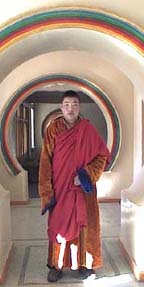
 hose Mongolian monasteries that survived destruction in 1937, slowly are beginning to rebuild. But not only must they replacing bricks, tiles, stonework and shattered images, they also must train a new generation of monks to carry on Mongolia's centuries-old tradition of daily Tibetan chanting and study of Buddhist texts. It's a massive task. So thorough was the Communist Party's suppression of Buddhism — destroying monasteries, forcing monks into civilian life, transporting them to Siberia or simply executing them — that no important Buddhist teachers survived the great purge of 1937, and all Mongolian teaching lineages were broken. A generation later, few middle-age and younger Mongolians understand anything at all about the Buddhist religion. But perhaps more important, the original Buddhist concept of monastic celibacy, with monks dwelling apart from the distractions of everyday living, has long been forgotten in Mongolia. Married lamas and monks living outside the monasteries are a centuries-old tradition in this country, despite periodic internal protests lamenting the loss of the pure original monastic ideal.
Historically, the Mongolian monasteries were an integral part of and reflection the state, to the extent that the Khutuktu's sang (the estate of the head of Mongolian Buddhism) as early as the 17th century was considered a fifth division of the Khalkha (the central Mongolian people), alongside the four Khanates. The extent of ecclesiastical Buddhism varied through the ages, but at most times over one quarter of the adult male population was directly connected to a monastery. As late as 1921, there were around 700 large monasteries in Mongolia, and over one thousand small ones, together collectively containing around 113,000 lamas until their destruction in 1937.
Unfortunately, Mongolian lamaism cannot be held up to the world as a pure and shining example of purity. The historical reality is a mixed one of outstanding academic achievement and spiritual accomplishment on one hand, while on the other is found great ecclesiastical wealth and political power, rampant with individual acts of brutality, corruption, sexual immorality and despotism. It was a hierarchy that rested on the exploitation and extreme poverty of the shabi, or ecclesiastical serfs — a dark but familiar pattern, similar to the mediaeval monasticism of Europe in the Middle Ages.
he brutality of mediaevalism is ended, although due to its isolation, Mongolia felt the shock of its passing centuries after most other societies. But the patterns of the past persist. Today, you can see young monks walking home after a day at the monastery, to return again in the morning. History is repeating itself in other ways: after an unsuccessful and too-late attempt at reformation in the late 1920s in response to the challenge of communism, the call to return to the original dispensation once again has come to the forefront. Responding to pressure from the Dalai Lama, head of the Yellow-Hat (Gelug) order of Tibetan Buddhism to which monasteries in this country belong, Mongolian monasteries are reluctantly beginning to tackle what the Gelug regard as a serious and continuing breach of the Vinaya, the Rules of the Order as laid down by Gautama Buddha.
Overcoming their traditional independence from each other, the monasteries recently formed a Buddhist Association, to enable discussion of what needs to be done to repair the ravages of the socialist era, and to re-establish themselves in response to the changed zeitgeist of westernized Mongolian society. This movement to return to the discipline and purity of the original monastic form is being led by a Ladaki monk, Bakula Rinpoche, who also is the Indian Ambassador to Mongolia and an Elder of the Order. He has been encouraging Mongolian monasteries both by speech and example, has established a Buddhist school in Ulaanbaatar to train young monks in the Vinaya, and is building a large temple to house them. The idea and impetus to form a Buddhist Association was largely due to him.
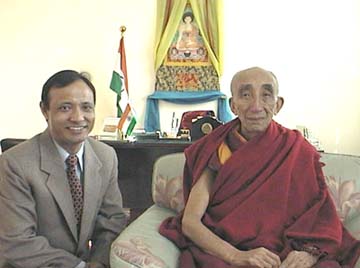
 went to see Ven. Bakula Rinpoche in his office at the Indian Embassy in Ulaanbaatar. Older students of Namgyal Rinpoche may recall his behind-the-scenes intervention while he was an M.P. in Delhi, to enable permission to be given for 108 Canadian dharma students to visit the late H.H. Gyalwa Karmapa's monastery in Rumtek, Sikkhim, in 1970. His long-time assistant, a Ladakhi named Sonam Wangchuk, was also was present at the meeting. Now in his seventies but still maintaining the full Vinaya discipline, Bakula Rinpoche was seated in an armchair in his large and sunny Ambassadorial office. He looked frail, much older than when I last saw him many years ago, in his M.P.'s office in Delhi. But his eyes were alert and bright, and he smiled as I reminded him of our previous meeting.
(On to Conversation with Bakula Rinpoche...)
(Back to Mongolian Buddhism In Crisis...)
(Back to Site Guide...)
copyright © Stuart Hertzog 1998