Part Three: A Conversation with Bakula Rinpoche
One man's mission to revitalize the monasteries
by Stuart Hertzog
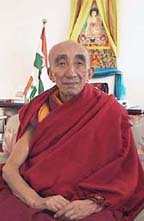
 eated in an armchair in his office, Ven. Bakkula Rinpoche spoke through his interpreter and long-time Ladaki assistant, Sonam Wangchuk. The noise of traffic passing by outside was hushed by the thick walls of the Indian Embassy. Bright, winter sunlight streamed in through the large windows, filling the room with white light that radiated rainbow colors as it reflected off the colorful Shakyamuni thanka (Tibetan-style religious painting) hanging on the wall behind the Ambassador's desk. I asked my questions, and Sonam translated, listening intently to the Rinpoche's reply. It was obvious from the easy flow between them and the fluidity with which Sonam translated the answers, that the assistant understood well his master's mind. It was a privilege and a pleasure to be in the presence of a great teacher and Elder of the Sangha, in such an atmosphere of loving support. I started the interview by asking:
What is the state of Buddhism in Mongolia today?
Mongolian Buddhism had a great history, producing many scholars who contributed to the development of Tibetan Buddhism. But 70 years of communism has torn down everything. Since the democratic progressive movement started ten years ago, reconstruction of the monasteries has been going ahead. But the problem is that there are very few qualified monks available to carry on the tradition. There were 700 monasteries in this country before, now they almost all have disappeared and their monks dispersed or killed. This loss to Buddhism affected the whole Mongolian cultural heritage. Almost all its art was lost, and many other things.
The condition of Buddhism in Mongolia today is like a plant that has dried out. It needs water and fertilizer so that it will revive. After the democratic movement got under way, there was great fervor to rebuild Buddhism. But Buddhism is true knowledge, and if there is no true knowledge available, then the fervor remains only a little flame. There is the performance of rituals in the monasteries -- there is relatively less concern about that -- but the real knowledge of Buddhadharma is lacking. What is impressive is the tremendous faith among the ordinary people. They may not understand the Dharma, but they have great faith. Their conviction is very strong.
There is a need to speed up the training of monks, so the revival can go smoothly. As far as monks are concerned, the Vinaya (rules of the Order) is a major concern because very few Mongolian monks uphold them. I believe that to be a monk and not to uphold the Vinaya is of no use. To say that Mongolian Buddhism is different and can have married monks, means perhaps the ordinary people won't respect them, and that would be no good. The purpose should be to help people spiritually. If that's not happening, what's the use of an Order? This is why there is a great need for education of the Order in the traditional ways. My preference is to have fewer monks, but of a higher quality.
Is this why you have established a training school for monks?
I have visited practically all parts of Mongolia, not just the cities and towns but also the villages. During this, I found that people have a strong desire to practice Buddhism, but are ignorant about what this means. Many people ask to be ordained, but think that to shave their head and wear robes is to be a monk. They have no real understanding of what it means to be a monk. So I decided to set up a school to train monks in the Vinaya. Pethub Stangey Choskhorling is named after my own monastery Pethub Gompay in Ladakh. The name means "Model Buddhadharma-Spreading Monastery," and its purpose is to demonstrate by example how to be a monk and how a monastery should be run. Incidentally, there has never been a tradition of nuns in Mongolia, so I also started ordaining nuns. At first, this met with resistance. But slowly, they are becoming accepted.
Do you believe that monks should live inside the Monasteries?
This is very important, otherwise what is the difference between a lay person and a monk? To be different from lay people, monks must live inside the monastery. This question arose when I was sending monks to India to be trained. I was asked: why not bring teachers here, wouldn't it would be much cheaper? I said that the monks need to experience the environment of a monastery so they can know what it's like to live as a monk. This should be the way in Mongolia, but although lamas here understand this, unfortunately there has not been any real adoption of this approach. They say that it is good, but that they don't do it this way here.
What about Buddhist education of lay people?
The bad thing about communism was that it destroyed Buddhist culture. But the good thing is the literacy rate is now high, so many people can read books and understand what they mean. In the last few years I have been working on translating basic Buddhist texts into modern Mongolian, and publishing and distributing them. If this is done, more people will have a better understanding of Buddhadharma.
What about the impact of Christian missionaries in Mongolia?
Almost 70% of Mongolians are young people, and recently it concern arose that many of them will adopt Christianity, as the missionaries make it attractive to them. They also have all the modern distractions of television and other things. But I have observed strong feelings of Mongolian identity among the young people. First and foremost, they want to be Mongolian. Then they find out that Christianity is different, and it becomes clear that it could affect their Mongolian culture. There are many economic reasons for them to convert, but in their deep heart they want to be within their own culture. This is very possible: all those countries considered to be modern, secular states, each have their own religion. You can have a strong religion, even in a secular state. There is no conflict between Buddhism and democracy.
Is there is a danger that Buddhism could become a minority religion in this country?
I don't believe this will happen. The main question is whether Mongolia can develop good Dharma teachers and monks. There has to be a strong effort to give people the opportunity to learn about and understand Buddhism, which is actually simpler than trying to convert them to Christianity or any other religion because it is part of their heritage. Once, I came to a place to give a talk, and a Christian missionary was preaching nearby. Soon, most of the audience left that person and came to hear me, because they wanted to find out about their own religion. It was nothing I did, it just happened. They heard that a lama was speaking in the area, and they just came. So if people are given an opportunity to hear Dharma, they will respond from deep within their heart. It is something that is at the center of their culture.
Has there been much response to the idea of a Buddhist Association?
Not much has been done, unfortunately. I have tried to encourage the young people to do something, but after their initial fervor they have not been very active. There is a great need for organization. In previous times, as I have said, although Mongolian Buddhists possessed a deep faith in their religion, not many understood it. Today, although people still have this inner faith, they know no Buddhist prayers or rituals, and anyway are so busy with the daily business of economic survival that they pay no attention to religion.
Have you received any response from Mongolian monasteries?
I'm sure there is a strong desire among the lamas in the monasteries to do something about the situation, but many factors stand in the way. They don't have many qualified monks, and many monasteries are struggling with economic concerns. They also lack experience in public relations, and the ability to speak directly to people to convince and educate them. Much more needs to be done, and one key factor is the potential role of Buddhists from other countries. Buddhists from outside Mongolia could do much to help rebuild the Dharma in this country. But in the past, none have come to help, leaving Mongolian Buddhists on their own. One visit from the Dalai Lama is very short, there must be a concerted effort on the part of Buddhists from other countries. I myself have had a long association, since 1968 initially, with Buddhists in both Russia and Mongolia. I first came to Mongolia in 1970 at the invitation of the Asian Buddhist Peace Conference, of which I am President, and have returned many more times since then. In January, 1990, I became the Indian Ambassador to Mongolia, and now am resident here.
How can foreign Buddhists be of help?
You must demonstrate how beneficial Buddhadharma can be; talk about how and why you are attracted to Buddhadharma; and tell Mongolians that you already have this tradition in your own country. People are going to be drawn to Buddhism because of what they discover about it. They have it already, but are not taking care of it. It's important for foreign Buddhists to impart their understanding of Dharma to Mongolians because in the past it was branded as a backward religion. So it is a more powerful statement coming from westerners, that Buddhadharma is relevant to this age.
Also very important is that foreign Buddhists can actively participate in the process of Buddhist revival in this country, by helping to set up societies and platforms for organized ways of reaching out to young people; and by doing translations and by publishing inspirational and educational Buddhist materials. The Christian missionaries are always doing this, as part of their effort to attract young people. Money plays an important role in these activities, of course. In setting up an organization, it is important to find the right people, without whom you cannot be effective. It is important to encourage people to support this revival, so who is involved is a key factor.
Do you see Buddhadharma changing in response to the modern technocratic global culture?
I generally accept the view that it is not always necessary to be rigid in one's approach. But we cannot change or compromise the basic teachings or the rules for monks and monasteries. These should not be disturbed. But as times change, new necessities and requirements emerge. For example, monks in my monastery in Ladakh used only to study Tibetan and Sanskrit. Now, they also learn mathematics and many other subjects. Western people have a different approach, they understand Buddhist philosophy in a more practical way. Buddhadharma is very scientific, and we have to go by facts. In this way, it is very suited to modern culture. Modernization is possible, but it is important to maintain the basics. The crucial questions are: What is Buddhism? And who are the monks? If the monks receive no respect, it's no use. These are spiritual matters and you cannot force people to accept you.
(On to Conclusions...)
(Back to Prescriptions for Revival...)
(Back to Mongolian Buddhism In Crisis...)
(Back to Site Guide...)
copyright © Stuart Hertzog 1998