Part One: Outbound from Ulaanbaatar
From Ulaanbaatar to Erdene Zuu
by Stuart Hertzog
NOVEMBER 3rd, 1998
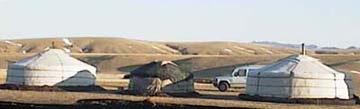
 et me describe this scene for you. It feels slightly surreal: I'm writing this on my very high-tech Powerbook in a beautifully-decorated and very traditional Mongolian felt-lined ger, which westerners mistakenly call a yurt. We're in a small village called Bangen Owa, across from the great walled monastery of Erdene Zuu near Kharkhorin, 375km west and slightly south of Ulaanbaatar. Outside, great clunkings and bangings echo across the valley from a nearby log-handling plant. The sun has set and the stars are steel-bright in the cold night sky.
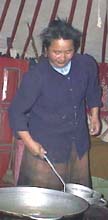
I'm with my generous hostess Enhknam, and my driver, Cekhbaatar. Along with two young monks from Erdene Zuu, we have just watched a slide show on the Powerbook of the digital pictures I shot back in Ulaanbaatar. The Mongolians were wide-eyed at the display. Now, Cekhbaatar is watching the Sony television in its place of honor next to the shrine, while Enhknam is cooking the evening meal on the low, metal stove, the centerpiece and most vital element of every Mongolian ger. It's pleasantly warm in here, but it's cold outside, and cool, fresh air is coming in through the half-open circular vent in the roof. Everything feels quite natural, and very much "down home".
 've finally left Ulaanbaatar and headed out to Shankh. What a relief! For the last two weeks, I had been waiting for Barsbold to fix his car. Barsbold (Bars) is the young guide who took Rinpoche and party to Shankh in June. He was keen to drive me to Shankh and be my translator, as he'd promised to help with the project. What with breaking a part while reassembling things after replacing the fuel pump, the endless running around to find a replacement (not an easy task in Mongolia), and having not heard from him now for the fourth day, the wait was simply too much. I just had to get going.
Yesterday, I checked a few tourist agencies and found one I liked and whose price was good. This morning, I just upped and left, sans translator, simply on faith that everything would work out. So far, all seems to be well. My stomach is full (my first meal of horsemeat -- very tasty, too. Mongolia is not for the squeamish), I have a warm place to lay my head, the Powerbook has survived the amazingly bumpy roads, and I'm surrounded by friendly people. I've presented my letter of introduction from Puruvbat, the artist monk at Gandan to his friend the Hambo Lam (Abbot) of Erdene Zuu, so tomorrow we will head down the road to Shankh, 25km away. It has been a full and interesting day, after the frustration of this morning's slow start.
Escape from the City
t seems to take ages to detach from Ulaanbaatar. Not knowing whether Bars simply would turn up, I delay ordering a vehicle until eight that morning. I also manage to give the tourist agency the wrong address: the fourth microdistrict instead of the third. My confusion stems from the Ulaanbaatar map, which lumps the third and fourth microdistricts together. But that was my mistake: I should have deciphered Javhlan's Cyrillic taxi instructions. So I pace up and down the apartment, my bags packed, watching the time tick by and anxiously calling and recalling the agency.
The young French-speaking Mongolian woman finally knocks at the door at 11:15a.m. -- apartment 21, by the way, not 78 as I had told them, she laughingly informs me -- Doh! I sign the contract, load my bags into the decent-looking silver Mitsubishi Pajero 4x4, and we set off. After a stop for the driver to pick up cigarettes and another for to tank up with diesel, we finally head out of the city, the seemingly endless industrial areas slipping by as we bump and swerve along the main highway west.
Snow lays on the brown cropped grasses in patches, painting the surrounding hills with broad brush strokes of white. Short stretches of slush occasionally cover the road, filling the potholes and making driving slippery. Soon, we come to a fork in the highway and swing left, away from the railway track and up into the hills, dodging and weaving on the uneven surface as we pass slower-moving Russian trucks and jeeps. Trucks pulling trailers are most difficult to pass, their single hitches and bad alignment emphasizing the driver's erratic course. Their back ends swing from side to side like drunken snakes, flailing across almost the full width of the highway. I begin to appreciate the value of prayer, trying not to hold my breath as we slowly pull by each dangerously-overloaded juggernaught.
 s the smoky excesses of Ulaanbaatar slip away behind us, the calm of the countryside slips over us like a warm comforter. Near Ulaanbaatar, the landscape is well-populated. We pass small villages, the more permanent-looking well off the highway, while strings of gers pitched right next to the shoulder offer rough-and-ready highway stops. To either side, large herds of sheep, goats and cattle brows incessantly, sometimes spilling right across the highway, oblivious to our passage, only moving away if our car startles some. Black-and-white and rich chestnut brown cows drink melted snow right off the highway surface itself. My driver takes it all in his stride, slowing only if some dreaming cow refuses to budge, or if a sheep rushes across in panic.
The weather starts to improve, the skies slowly clearing out as we progress further west. Soon, it is a glorious day. The sun shine bright-white, the sky becomes startlingly blue, and the glorious vistas of the Mongolian steppes open to our gaze. Mountain ridges many tens of kilometers away seem close enough to touch, their steep, ragged slopes and ridges contrasting with the broad reaches of the imperceptibly-sloping valleys. Everywhere, herds of animals mark the grasslands, their massed dots occasionally accompanied by distant figures of Mongolian herders on horseback, each effortlessly balancing a long, uurag lasso pole used to snare a galloping beast.
We pass through an area that seems to specialize in cattle, and another dominated by large herds of horses. Sheep and goats mark another. Large smoking abattoirs in each area presage the fate of each animal. A pale brown fox hurries across in front of us, scurrying for cover as Cukhbaatar, my driver, pulls over to hunt it, until I motion him to continue. Suddenly, I see a long-tailed mouse or rat, its silhouette sharply outlined as it dives between the wheels of an oncoming car. I wonder if it survives. Another tailless scurrying gopher-like creature safely makes the far shoulder.
Birds begin to make their presence known. An eagle soars in the distance, while large hawks swoop low over the land to pick off small rodents, or to harry flocks of sheep for their tasty newborn. Twice, we see a beautiful spotted hawk, perched low on a roadside post. The second time, the driver chuckles as he swerves almost up to the animal, the startled look in its eyes clearly visible just a couple of feet away. The birds seem to grow bigger; eventually, we see half a dozen huge, black vultures perched on a hillside, their eyes fixed on a herd of goats. Truly, the Mongolian countryside is alive.
Meeting at Erdene Zuu
 harkhorin, marked on the map as a town near, isn't much of a place, just the usual collection of decrepit Russian industrial plants, a few institutional buildings, and the usual huddle of wooden-fenced plots containing gers. Nothing for us here, and anyway, it's getting late in the afternoon and we must find a place to spend the night. So we turn north to the walled monastery of Erdene Zuu. The driver hammers on the brightly-painted but firmly-locked gates. They are opened by a watchman, and he and my driver dialogue in voluble Mongolian. We walk inside and meet two women leaving after their day's work. Luckily -- what long odds! -- one speaks halting English. She will take us to the Hambo Lam, who has gone home for the day.
The Hambo Lam of Erdene Zuu is is young man named Namchai Jampts. He is in his twenties, with the clean, delicate features and quiet, gentle demeanor that is the mark of many Tibetan and Mongolian incarnate lamas. I duck my head to enter the low doorway of his ger. Inside, the richness of a well-equipped shrine greets my eyes. The Hambo Lam is sitting on the floor to the left of the shrine; I take my place on the proffered stool, to his right, and present the letter from Puruvbat. We talk through the stilted agency of my new-found translator. "If I had met you in Ulaanbaatar, I would have helped you to get here," says Hambo Lam. "What can I do for you now?" he asks.
I explain that we need a place to stay for tonight, and directions for Shankh tomorrow. "Would you like to stay in an hotel?" he asks. I shrug my shoulders: "Wherever is best." After much conversation in Mongolian, my translator abruptly rises and pulls me outside. I nod farewell to the Hambo Lam, and manage to bang my head on the low door lintel. "Doh!" I exclaim. Everybody laughs. Oh well, that was my very first exit from a ger. Now I know why Mongolians are generally short: the tall ones are too knocked senseless to be able to propagate. Natural Selection, literally, strikes again.
(On to Part 2...)
(Back to Site Guide...)
copyright © Stuart Hertzog 1998