Part Two: Erdene Zuu Morning
Across the wide open spaces
by Stuart Hertzog
 t is that beautiful, quite time just before dawn, when I am awakened from my comfortable slumber by our hostess Enkhnam silently rising to light the fire in the stove. I take the opportunity when she goes outside to quickly throw on my clothes and step out into the cool morning air. The sun has not yet risen, and the almost full moon not yet set. The clear sky is brightening as I fill my lungs with fresh air, such a welcome change from the coal-fired pollution that hangs low over Ulaanbaatar each morning. Twittering birds flash by overhead. A dog barks in a neighboring compound. It feels good to be alive, and to be here in this place.
I walk to the toilet in the corner of the compound, taking care not to step between the gaps in the planks or drop anything into the festering pit below, then return to the ger, one of three in that compound. Cekhbaatar the driver has gotten up, and Enkhnam has breakfast well under way, a sweet rice porridge washed down with milky tea — not a bad way to start the day. The morning news on the television is a reminder of the city we have just left, and the busily ongoing world beyond Mongolia. We pack our bags and drive through the wakening village to Erdene Zuu monastery, where Enkhnam works and where we will meet the Lama who will be our guide to Shankh.
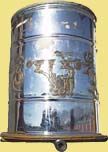
 rdene Zuu is one of the wonders of Mongolia. I hope you get to visit it one day. Built in 1586 and after by Abdai Khan from stones taken from nearby Kharakhourum, the imperial capital of successors of the great Ghengis Khan, the high walls of the huge compound are embellished with 180 stupas, 24 per side plus four at each corner. Some magnificent buildings survive inside this mediaeval religious complex, but they now are only a museum to attract and impress tourists. Only one small temple remains active, and it is towards this that Enkhnam leads us, stopping momentarily in her daily ritual of touching each holy place and spinning the many prayer wheels as we proceed across to the far corner of the compound. I am reminded of the deep faith in Buddhism that once pervaded this culture, and which many Mongolians still cherish despite years of brutal suppression and neglect.
We enter the temple, pushing aside the heavy felt curtain that keeps out the winter air. Stepping into the colorful interior with its sweet, incense-scented atmosphere is like stepping back in time. The Hamba Lam sits cross-legged on a raised flat seat on the left before the huge shrine. Young monks huddle over their books beside him, their noses almost pressed against the regular, black lettering on the wide, hand-printed sheaves of Tibetan texts. The Hamba Lam looks up and smiles. "I see you have rested well!" he says quietly. "Thank you, very well," I cheerfully reply. It was indeed a good sleep and a good morning. We sit down to wait, accepting an offering of snuff in a small, decorated glass bottle from a dell-clad herdsman. We pretend to take some, exclaim how good it is, and pass it back, the top slightly open, a common courtesy in Mongolia. It is deemed offensive to refuse.
 fter a while, I am motioned forward and present my blue greeting scarf to the Hamba Lam, receiving a blessing in Tibetan in return. We smile and leave, crossing to the next building to climb a tiny, steep stairway to reach Enkhnam's office. She goes first, untwining from the trapdoor hasp the red blessing thread that functions as the security system. Woe betide any unfortunate that breaks that thread! Never mind the Police, it's the local Dharmapalas (fierce Buddhist guardians) he or she will have to escape. Ah, the advantages of faith. It certainly is a more happy-minded alternative to the high-tech paranoia of the systems we use in western countries. Here, it works better than any video camera — hey bud, Buddha is watching you!
Tracks and Wires
sit waiting in Enkhnam's upstairs office, with its incredibly low roof and tiny windows looking out onto the mediaeval landscape of temples and stupas. What an amazing sight! I am transported not only through space, but also back in time, feeling as though I am in another incarnation, long ago. The Det (assistant Head) Lama arrives and the magical interlude is almost broken. He's an energetic, bustling character, and after a few moments of attending to the business of the day, we leave. A car is waiting for us outside, to ferry us to our vehicle. Cekhbaatar is waiting, anxious to leave.
It's another beautiful day, with a picture-perfect, deep blue sky, and bright fall sunshine. We head south, past the intersection of the Ulaanbaatar highway. Within a few hundred metres, the asphalt surface ends, and we are onto the dry, undulating natural terrain, following those meandering and wide tracks that I had seen from the air on the flight into Mongolia. We follow the Det lama's car as is careens from one track to another. It stops at an intersection of three tracks. From the agitated hand movements and erratic turning of the vehicle, I gather that not even the locals are sure which way to go. Eventually, they choose a direction, and we follow.
fter the bumpy, potholed and dangerous highway of yesterday, it's a pleasure to be going across the wide open spaces of Mongolia, choosing our path as best suits us. The land is not quite flat, but angles slightly to the bottom of a vast valley to our left. A line of electricity pylons marches across the plain, pointing the way south. At one time, we race along beneath the wires, thankful that they are at least there as a sign that there must be a settlement ahead. I guess the locals are thankful too — there have been cases where whole sections of Mongolia's electricity grid were stripped of their copper wire overnight, to be sold on the black market back to the state electricity company, meanwhile depriving huge areas of the country of electric power.
The road wanders away from the power lines, towards some hills. The track narrows to cross a river, and as we round a low bluff by the river, I realize that we are passing through a beautiful rustic area, a veritable beauty-spot, with sheep and black goats grazing by the stream, while a herd of horses stamps about in the distance. What a pretty country! It must be very lovely in the summer, after the rains have freshened the grasses and brought color back to the edges of the stream.
Shankh at last
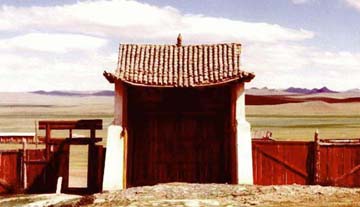
t takes about an hour to reach the village that surrounds the Shankh monastery. We approach, ascending a slight hill towards the settlement, which sits on the edge of the valley, just as it rises into the hills to the north. We drive through the usual collection of wooden-fenced compounds that mark out the areas surrounding the family gers, and suddenly, the gates to the walled monastery compound are ahead. We stop the vehicles outside and walk into the compound. A thrill of excitement rises inside my chest, an eager anticipation that marks the end of a long journey.
In front of us, three gers sit side-by-side;. Behind them are three buildings, the outer ones smaller than the center structure. My hosts usher me inside the left-hand ger. The smell of incense and the familiar droning of Tibetan chanting assail my senses, so strong and heavy after the fresh air of the surrounding land. It's a scene from out of a picture-book: two rows of monks sit cross-legged on low, painted benches, in front of a tiny altar and surrounded by thankas and painted wooden chests. Without stopping the chanting, the monks look up, interested by my arrival.
I hold the blue katag greeting scarf awkwardly in front of me, not knowing what to do with myself, or to whom to present it. The Det Lam of Erdene Zuu bows to the shrine, his head touching the floor in the traditional Buddhist gesture of homage to the Triple Gem. I follow his example, grateful to have made the long journey in one piece and finally to be here, so far away from the comforting safety of western Canada. It's been quite a trip, including all the hassle of getting out of Ulaanbaatar. Shankh at last! The Det Lam presents his scarf to the shrine, and I do also, draping it behind the tiny Buddha figure that sits on the low shrine.
I sit down on a proffered stool, and watch as the Det Lam talks to a young-looking and well-dressed monk who is sitting opposite the elderly monk who is leading the chanting. In a few moments, the Det Lam and the young monk get up and leave, motioning me to follow. Once again, I hit my head on the lintel of the ger. Ouch! What an impression this blundering westerner must be making. Will I never get used to these low doorways? I step outside, into the bright late morning air. And now the story can really begin....
(Back to Part 1...)
(Back to Site Guide...)
copyright © Stuart Hertzog 1998