Part Four: Towards a Modern Buddhadharma
Is this the end of Mognolia's feudal monasticism?
by Stuart Hertzog
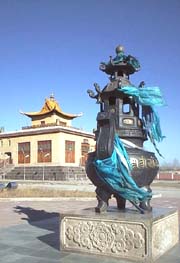
 he difficulties faced by Mongolian Buddhism at this time are due not just to the historical repression of the religion by the Mongolian Peoples Revolutionary Party. Undoubtedly, the destruction of the monasteries and the brutal liquidation of the remaining high lamas in 1937, followed by years of incessant anti-religious propaganda in the state-controlled press and public schools, plus the prohibition of any teaching of the religion to three generations of Mongolians, utterly destroyed the political and spiritual powerbase previous enjoyed by the religion. But more than just buildings, lamas and teaching lineages were erased by the destruction of Buddhism, and it is unlikely that the religion will ever again become dominant in this Asian country. The survivors that re-emerged from hiding in 1990 with the onset of Mongolia's glasnost found themselves in a secular and scientific society that no longer was prepared to accept unquestioningly the teachings of the Buddha or the superiority of the Lamas, or which gave Buddhism special protection from other religions.
Like most developing nations, modern Mongolia is galloping as fast as it can down the road towards being a free-enterprise democracy, urged along, as always, by the carrots and sticks of the World Bank. The rigid, centrally-controlled, single-party authoritarianism has been cast aside as a failed social experiment. In its place is a competitive, capitalist, market-directed, pluralistic neoliberalism that calls itself a democracy. Communism came to Mongolia to destroy nomadic feudalism and introduce state socialism, scientific industrialism, and the dictatorship of the proletariat, and it succeeded in its task. That there was no proletariat because there was no industry, and that state Socialism without a proletariat would lead as in the USSR straight to dictatorship, was only to become clear in hindsight.
This is not to say that Communism did not achieve some useful ends in Mongolia. It abolished the degrading aspects of feudalism, and introduced universal schooling and access to modern medicine. As a result, Mongolians enjoy one of the highest literacy rates in Asia, and generally are in good health. While not supporting the methods or brutalities of Communism in any way, most Mongolians quietly appreciate the disappearance of feudalism and the introduction of western scientific thinking. Some even quietly lament the passing of the more dependable ways of Socialism. "Everyone had an apartment, a job, and food on the table," they complain. "Now, even teachers, nurses and doctors have to struggle to survive. You can't depend on anything any more, and the young people care only for themselves." Whether rampant, free-enterprise capitalism is actually an improvement over state socialism or feudalism, or whether the Middle Way is found in those economies that retain some sort of social safety net, remains an open question.
Democratic Buddhism
 ne of the strengths of Buddhism has been its ability to adopt its forms and methods to a new culture, as it spread into different countries. It also evolved over time as a philosophy, moving away from its original renunciatory roots towards the world-embracing positivism of the Mahayana. At any time, for better or worse, it was a reflection of the host society. In Tibet and Mongolia, it was hierarchical and feudal, with a huge separation between the nobility and high lamas, and the often illiterate serfs and common people. The religion was the state, and the high lamas its rulers.
If I learned anything from my brief sojourn in Mongolia, it is that while traditional Tibetan-style Buddhist lamaism has preserved much of the teaching of the Buddha, it also had many warts. Although I went to Mongolia to find out if it was possible to help revitalize Mongolian Buddhism, after seeing it at first hand and studying its history I started to see the strengths of our own fledgling Buddhist culture. Western Buddhadharma is a very different animal indeed, and I have begun to appreciate it more. Lineage and tradition are given great importance in Buddhism, but no spiritual teaching can be contained forever within any particular historic religious format.
Today, I believe that the demand is for a more democratic Buddhism, one that does not treat its followers as idiots, or expect blind faith in anyone wearing a robe. Scientific thought evolved as a way around the intellectual roadblock set up by the mediaeval churches, who stifled natural curiosity in order to reinforce their spiritual and temporal power. Traditional Buddhadharma accepts and approves of natural curiosity, and disproves of blind faith and empty ritual. "Know it for yourself," is a keynote of the teachings of Sakyamuni. In many ways, Buddhism is very suited to mating with western science, and indeed, the teaching of Interdependence can be compared directly to Einstein's doctrine of Relativity.
 uddhadharma is thus an excellent foundation for a democratic spirituality suited to our freedom-loving scientific age. Indeed, at this time Buddhism is the fastest-growing religion in many western countries, as the last Canadian census revealed for that country. Democratic Buddhism respects lamas for their spiritual attainment and ability to teach, and demands that their teaching be available in a language that everyone can understand. It includes the opportunity for anyone to learn and practice meditation, and is open to all. This is what I want, and this is what all the Mongolian Buddhists I met in Ulaanbaatar told me that they want, and this is why we have established the Dharma Center of Mongolia to create teaching facilities for lay people, to translate and publish Buddhist texts, and to host teachers and students from throughout the world.
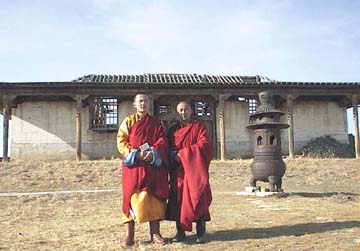
At the same time, I believe that the Tsogchen (Mahamudra) temple at Shankh Khiid should be rebuilt as an homage to the past and a place for the faithful to worship, as they did until it was brutally taken from them. A rebuilt Shankh Khiid can be a place to train a new generation of monks, one perhaps even better than their predecessors, thus maintaining a tradition which has existed in Mongolia since Kublai Khan chose Buddhism as the religion of his vast Mongolian Empire, and the great scholar and artist Jebtsundampa Khutuktu Under Geneen Zanabazar established Shankh Khiid as his favorite western residence in the lovely land of the Mongols.
FINIS
(Back to Conversation with Bakula Rinpoche...)
(Back to Prescriptions for Revival...)
(Back to Mongolian Buddhism In Crisis...)
(Back to Site Guide...)
copyright © Stuart Hertzog 1998