 Linear and Non-linear
Footnotes
References
Other Advantages
Linear and Non-linear
Footnotes
References
Other Advantages
Linear and Non-linear
Footnotes
References
Other Advantages
Linear and Non-linear
Footnotes
References
Other Advantages
Hypertext and Hypermedia are new ways of presenting and browsing through information. They have been made possible by electronic technology, and need a computer to work. They are revolutionary in that they enable us to absorb information in a more natural way than with paper-based books and pictures.
Hypertext is text which contains links to other texts. Hypermedia is hypertext which also contains other media, such as graphics, sound, and video. Both these terms were coined in 1965 by Ted Nelson, a visionary guru of hypertext.
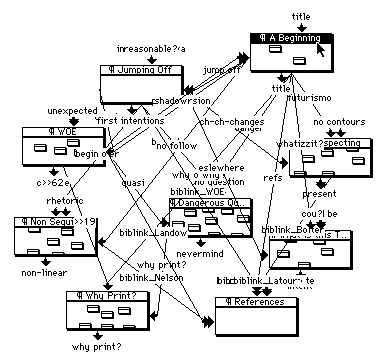
ABOVE: A map of a hypertext web of interconnected articles. Each box represents an
article, with elements of that article inside. The starting point is at the top right.
You can jump around between articles any way you want.
The importance of hypertext and hypermedia has to do with the difference between linear and non-linear thinking. You may have heard about
the difference between our left brain and the right brain. Researchers have discovered
that for most people, the left brain controls logical thought processes, like math
calculations, while the right-brain is where we do our intuitive thinking, such as
when we draw, paint or play music. Depending on our characteristics, each person
generally favours one side of the brain over the other.
Hypertext and Hypermedia allow us to do left-brain things in a right-brain way. Because we use both sides of our brain together, not only are they more fun, they also let us use our full mental capacity.
The World Wide Web uses both hypertext and hypermedia to build text and graphical pages that can be read by anyone with a suitable Internet connection and reader software. Using a desktop computer and a modem, you can feast on up-to-the-minute information from sources all over the planet, quickly coming up to speed on the state of any art or science. Or, you can become an information publisher, at a very reasonable cost.
There are other advantages to online, electronic hypermedia.
![[Forward]](../buttons/forward.gif) On to the Summary
On to the Summary
![[Back]](../buttons/back.gif) Back to the Overview of Web Publishing
Back to the Overview of Web Publishing
![[Up]](../buttons/up.gif) Up to the Contents page
Up to the Contents page